


The complete car immobiliser buyer’s guide for UK drivers
Methods, what to look for, what to check, insurance implications, installation, and a full product recommendation matrix. Everything you need before you spend a penny.
A car is stolen in England and Wales every three to four minutes. In more than 70% of cases, no key was needed and no alarm was triggered. Factory security – the immobiliser and keyless entry system your manufacturer fitted – was not built to stop this. Aftermarket immobilisers exist to fill that gap. This guide tells you everything you need to know to choose the right one.
We’ve written this as a genuine reference – not as a thinly veiled advertisement for our own products. Our engineers have each spent more than twenty years in automotive electronics, and we manufacture across every immobilisation architecture, so we have no reason to talk one method up and the others down. Where a LockCar product is the right recommendation, we’ll say so and explain why. Where it isn’t, we’ll say that too.
Why factory immobilisers fail against modern theft
Every car sold in the UK since 1998 is legally required to have a factory immobiliser. These systems work by verifying that the electronic key chip communicates correctly with the ECU before allowing the engine to start. For the first decade of widespread adoption, they were highly effective.
Modern relay attacks have changed the equation entirely. A relay attack doesn’t bypass the factory immobiliser – it makes the factory immobiliser irrelevant by amplifying your real key’s signal across a distance it was never designed to travel. From your car’s perspective, the key is right there. The factory immobiliser checks out. The engine starts. The car is gone.
An aftermarket immobiliser adds a second authentication layer that operates independently of the key system. Even if a thief relays your key signal perfectly – even if your car thinks your key is right next to it – a properly fitted aftermarket immobiliser means the engine still won’t start. That is the gap factory security leaves open, and it is the gap a good aftermarket product fills.
For a full explanation of how relay attacks work, see: How relay attacks steal keyless cars in under 60 seconds →
The immobilisation methods available in the UK
Not all immobilisers work the same way. Understanding the differences in method will help you ask better questions and make a more informed choice. Here are the approaches currently available in the UK market – all of which we design and manufacture in-house.
- No visible hardware once fitted
- Plug-in and fully reversible
- Full app, GPS and 4G options
- Covers cars, vans, EVs, hybrids, HGVs
- Validated profile per make, model, year
- Correct sleep behaviour when parked
- Diagnostic verification after fitting
- Very low-impact integration
- No visible hardware
- Full app and tag operation
- Platform-dependent availability
- Vehicle profile required
- Works without a CAN profile
- Well suited to older and commercial vehicles
- Very robust in mixed fleets
- Vehicle-specific wiring
- Longer installation on some models
- No vehicle profile needed
- Works on any 12V or 24V vehicle
- Nothing for a remote attack to talk to
- Layers well with bus integration
- Professional concealment essential
- Physical access to the circuit
- Hands-free – no user action required
- No lockout risk
- Partners can use independently
- Tag must be carried
- Range varies (1.5m–5m typical)
- Recovery as well as prevention
- Remote response capability
- Monitoring evidence for insurance
- Mobile coverage for remote features
- Core arming must work offline
- Cheap and easy to fit
- Closes a specific vulnerability on older vehicles
- No professional installation required
- Does not protect against relay attacks
- Not an immobiliser – a supplementary layer only
- Less relevant on post-2018 vehicles
The most important thing in this list is not which method is “best” in the abstract – it’s which one is right for your specific vehicle. A validated CAN integration on a modern platform, a LIN or ADC solution where CAN isn’t the answer, a physical relay cut on an older or commercial vehicle, or a combination on a high-value car. For a full explanation of each: CAN bus, LIN bus, ADC and relay – how each method works →
What to look for – and what to check
Use this checklist when evaluating any immobiliser product or installer. Items marked Must have are non-negotiable for a competent installation. Items marked Should have add meaningful value. Items marked Avoid are genuine warning signs.
A method matched to your vehicle
Ask which architecture is being proposed for your car and why. On a modern platform that means a validated CAN or LIN profile for your exact make, model and year. On an older, imported or commercial vehicle it may mean ADC or a physical relay cut. An installer who fits the same method to every vehicle regardless of platform is fitting what they stock, not what you need.
Professional installation with concealment
An immobiliser that a thief can locate and bypass in 90 seconds provides almost no protection. Professional installation means the hardware is hidden in locations that require significant disassembly to find – not under the dashboard in plain sight.
Single point of accountability
You must be able to reach someone who can resolve a problem with the installation. Where the manufacturer and the installer are unrelated businesses and something goes wrong, you can end up between two parties. The strongest arrangement is one team that manufactured the product, trained the engineer, and stands behind both.
Hands-free or app-based disarming
Proximity tag or app disarming removes the risk of lockout, partner confusion, and the friction of a PIN sequence. The IS357’s 5m detection range means the car is disarmed before you reach the door. No codes to forget. No timed lockouts. No explaining the sequence to your partner.
App monitoring and alerts
Motion alerts, arming status, and the ability to check your vehicle’s security state remotely add meaningful value – particularly if you park away from home overnight, use public car parks, or own a vehicle in the most-targeted makes. The ONE Plus adds live camera and 4G remote immobilisation for owners who want full visibility.
Compatibility with your vehicle type
EVs, HGVs, motorhomes, and hybrid drivetrains have specific electrical architectures. Not every immobiliser is rated for 24V systems or designed to work safely with hybrid power management. Confirm compatibility before purchase. LockCar products work on all 12/24V vehicles including cars, vans, EVs, HGVs, and motorhomes.
Unverifiable technical claims
If a product claims network integration but the manufacturer can’t tell you which circuits it touches, how it handles bus arbitration, what the measured quiescent draw is on your car once it sleeps, or what vehicle-specific testing has been done – treat that as a warning sign. Those are the questions a competent manufacturer answers immediately.
Cheap online units fitted by non-specialists
A £25 immobiliser from an online marketplace, installed by someone without vehicle security specialisation, is worse than no immobiliser in some respects: it creates a false sense of security, may interfere with vehicle wiring, and is trivially bypassed by anyone with basic knowledge. If you’re going to invest in protection, invest in the full solution.
No post-installation support
What happens if your tag stops working at 11pm? What if a firmware update is needed? What if your car goes into a dealer and the technician needs to know what’s fitted? An immobiliser that comes with no ongoing support structure – no phone number, no direct line to someone who knows the product – is a product to avoid regardless of its other specifications.
Price guide: what you should expect to pay
Price in this market correlates moderately well with quality – but not linearly. The most expensive option is not necessarily the best. Here’s a realistic breakdown of what different price points actually buy you.
Budget online units – DIY or non-specialist fitting
Generic units, OBD locks, and basic alarm add-ons. Not designed for concealment. Trivially bypassed by informed thieves. May interfere with vehicle wiring if fitted incorrectly. Acceptable only as a supplementary layer on top of a proper installation – never as primary protection.
Professional standalone systems (IC3ST / IS357 / CAN-IMMO)
The sweet spot for individual car owners. UK-manufactured units with full app control, proximity tag, and hands-free operation, specified with the integration method that suits your vehicle. The IC3ST and IS357 are standalone – no additional MCU required.
Combined dashcam + immobiliser with GPS and 4G (ONE Plus)
Fleet-grade specification: live camera, GPS+GLONASS, 4G remote access, automatic night immobilisation, Face ID, and full remote immobilisation from any location. The ONE Plus delivers this at £199 because it is manufactured directly rather than resold.
LockCar systems professionally installed
The all-in price for most individual car owners – product, vehicle-matched integration, professional concealment, app setup, and direct access to the engineers who built it. This is the band most owners should be budgeting in.
Premium aftermarket systems via national installer networks
The typical installed price when a product passes through a distribution chain: manufacturer, distributor, approved installer, customer. The protection is genuine; part of the price reflects the intermediary layers rather than the engineering.
Insurance-approved Thatcham systems with monitoring subscription
This tier is designed primarily to satisfy insurer requirements on high-risk vehicles – often mandated for Range Rovers, certain performance models, and other high-theft vehicles. These systems typically include GPS tracking and a monitoring centre subscription. The right choice if your insurer specifically requires a Thatcham-approved device.
The right question isn’t “how much should I spend?” It’s “which method suits my vehicle, and who is standing behind the installation?” A £139 system correctly specified and professionally concealed will outperform a more expensive one fitted to the wrong platform. Method and installation matter more than price band.
Installation: what good looks like
The quality of installation determines the real-world effectiveness of any immobiliser as much as the product itself. A professional-grade product poorly installed is trivially bypassed. Here is what distinguishes a good installation from a bad one.
Warning signs in an installation
- 🚩 Hardware visible under the dashboard without disassembly
- 🚩 Wiring run in obvious paths along existing looms
- 🚩 Installation completed in under 30 minutes on a complex vehicle
- 🚩 No app setup or pairing performed during installation
- 🚩 Installer unable to explain where the hardware is physically located
- 🚩 No documentation of what was installed and where
- 🚩 Vehicle returned with unexplained new warning lights
What a good installation includes
- ✓ Full disassembly of relevant panels for concealment
- ✓ Hardware placed in a non-obvious location requiring significant access time to find
- ✓ Diagnostic check after fitting on network-integrated systems
- ✓ App paired and tested before the engineer leaves
- ✓ Tag detection range confirmed in situ
- ✓ Owner walked through app features, tag operation, and valet mode
- ✓ Installation certificate and a direct contact for follow-up
“When it goes faulty you are stuffed – only your installer can sort it out. So choose your installer wisely.” – UK car owner, automotive forum
 The LockCar difference
Fitted by the preffesional team network Lockcar.
The LockCar difference
Fitted by the preffesional team network Lockcar.
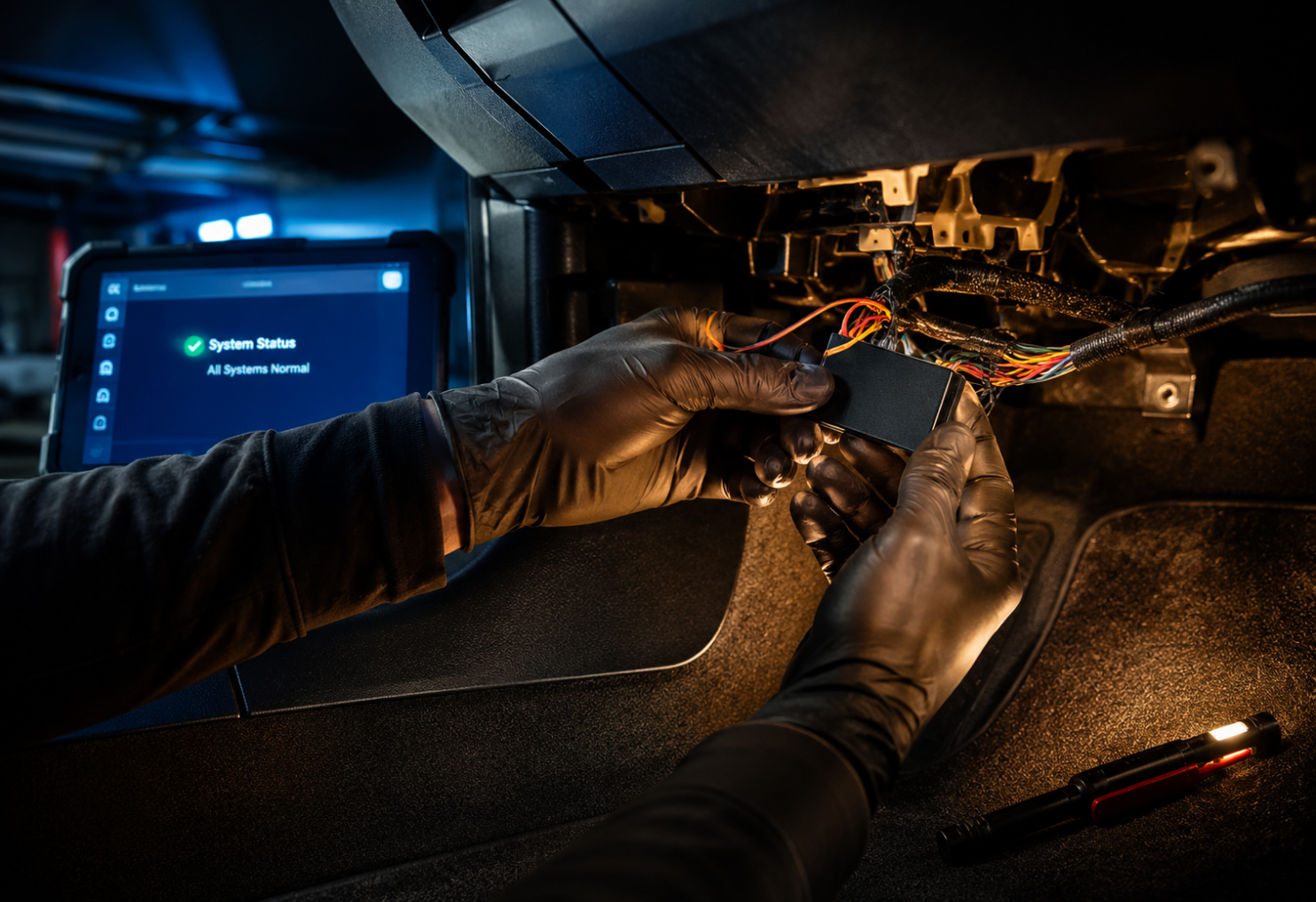
At LockCar there is no separation between the manufacturer and the installer. The engineers who designed and built the device are the same team that fits it at your address, and every engineer working under our name has been through our vetting and certification: proven auto-electrical background, verified experience on modern vehicle networks, training on our own hardware across CAN bus, LIN bus, ADC and relay, and documented installations audited against our standard. The app is configured, the tag detection range confirmed, and every feature demonstrated before we leave. There is no communication gap between the people who made it and the person who fitted it.
Immobilisers and your insurance
The relationship between aftermarket immobilisers and car insurance is nuanced and worth understanding before you buy. Here is what the data and insurer communications tell us.
What you should know about immobilisers and insurance
- Some insurers – particularly for high-risk vehicles like Range Rovers and performance models – now mandate Thatcham-approved security systems as a condition of cover. If your insurer has specified a Thatcham category requirement, a non-Thatcham product may not satisfy that requirement, regardless of its technical quality.
- Thatcham approval is a certification process run by the Motor Insurance Repair Research Centre. It does not necessarily mean a Thatcham-approved product is technically superior to a non-approved one – it means it has been through a specific testing and certification procedure that insurers recognise.
- If your insurer has not mandated a Thatcham product, fitting any professionally installed immobiliser may reduce your premium or be viewed positively at claim time. Call your insurer and ask directly – the response varies significantly between providers.
- Keep the paperwork. A proper installation certificate showing the device serial number, date, vehicle registration and a technical description is what most insurers ask for when applying a security discount, and it is what you want on file if you ever need to make a claim.
- An immobiliser does not replace a tracker for insurance purposes. If your insurer requires a Thatcham-approved tracker (common for Range Rovers), that is a separate requirement from an immobiliser. The LockCar ONE Plus includes GPS+GLONASS tracking – confirm with your insurer whether this satisfies their tracker requirement.
- Always inform your insurer when you fit aftermarket security. Failure to disclose a modification – even a beneficial one – can in theory be grounds for declining a claim. The conversation takes five minutes and protects you.
Will an aftermarket immobiliser affect your car’s warranty?
This comes down to how the system is installed rather than which technology it uses, and it is worth a five-minute conversation with your dealer before any work is booked.
What matters is that the installation is non-invasive and reversible. A system fitted using the vehicle’s existing connectors, with no cut or spliced wiring, can be removed to leave the loom exactly as it was. That is straightforward to explain to a dealer and straightforward to undo. An installation that cuts into the loom is harder to reverse, awkward in a warranty conversation, and visible to any technician doing diagnostic work.
The other thing that matters is documentation. A dealer who knows exactly what has been fitted, where, and by whom has no reason to treat it as an unknown variable. Every LockCar installation comes with a certificate covering the device, the vehicle, the date and a technical description, and our engineers will explain the system to your dealer directly if that is ever useful.
If your vehicle is under manufacturer warranty: call your dealer or manufacturer’s warranty team before booking any aftermarket security work and ask what they need to see. Get the answer in writing if you can, and keep it with your installation certificate. It takes one phone call and removes the question entirely.
Red flags: what to avoid when buying
The vehicle security market has a number of operators who are not what they present themselves to be. Here are the warning signs to watch for when evaluating any product or installer.
An installer who can’t explain what they’re fitting or where
A professional installer should be able to tell you the product name, the manufacturer, which method is being used on your vehicle and why, and approximately where the hardware will be located. If the answer to any of these questions is vague or evasive, find someone else.
Unlabelled vans and no company credentials
Several UK forum users have reported being ripped off by “mobile immobiliser fitters” with no company identity, no insurance, and no recourse if something goes wrong. Verify the company exists, has a website, has reviews, and has a physical presence before you let them near your car’s wiring.
Products making “unhackable” or “unstealable” claims
No security product is absolute. A well-fitted professional system makes theft dramatically harder and buys significant time – that is a realistic and valuable promise. Any product claiming total, unbeatable, guaranteed security is either ignorant or dishonest. The goal is to make your car a harder target than the unprotected car next to it.
No phone number – just a web form
A security product is not a commodity purchase. You need to be able to reach someone when something goes wrong – at 10pm on a Sunday if necessary. If a company’s only contact is an online form with a 48-hour response commitment, that is not acceptable support for something protecting a £30,000 asset.
Products that require internet connectivity to arm or disarm
If an immobiliser requires a live internet connection to arm or disarm the vehicle, a mobile signal outage, app server downtime, or subscription lapse could leave you locked out of your own car. The primary arming and disarming function must work offline – additional features like remote access should be online-dependent, not the core function.
Frequently asked questions
No security measure prevents all theft absolutely. A professionally fitted immobiliser dramatically raises the difficulty and time required to steal your vehicle – making it a much harder target than any unprotected car nearby. Determined, well-resourced theft teams may attempt to locate and bypass any device given enough time. The goal is to make your car the harder option, not the impossible one. Most relay attack teams will move on when the engine fails to start.
A professional installation by an experienced engineer typically takes 45–90 minutes depending on the vehicle. Vehicles requiring more disassembly for proper concealment may take longer. Any installation completed in under 30 minutes on a complex vehicle should be viewed with scepticism – proper concealment requires time.
Yes. Our systems operate on the 12V auxiliary side rather than the high-voltage drivetrain, and are rated for all 12/24V systems including EVs, hybrids, HGVs, and motorhomes. EV network architecture is typically more complex and more tightly controlled than in combustion vehicles, which is exactly why we validate a profile per platform before we integrate – and why we will recommend a standalone system instead if a validated profile isn’t available for your vehicle.
A well-designed system has a fallback. LockCar products include a valet mode and alternative disarm method precisely for this situation. Ask about the backup disarm procedure before any installation – you should never be in a situation where a flat battery or lost tag permanently locks you out of your own vehicle.
It depends on the platform. On a modern vehicle with a validated profile we would usually specify CAN bus integration, often layered with a physical relay cut on higher-value cars. Where the cleanest integration point sits on the comfort network, LIN is the better answer. On older, imported, commercial or heavily modified vehicles, ADC or a standalone relay system is the right engineering call. Send us your make, model and year and we will tell you which one we would fit and why. Full detail here: CAN bus, LIN bus, ADC and relay →
Range Rovers are among the most stolen vehicles in the UK and are specifically targeted by organised theft rings. For this vehicle class we recommend the LockCar ONE Plus – the combination of vehicle-matched immobilisation, night auto-arming, GPS tracking, and 4G remote access provides maximum protection and remote response capability. The IC3ST is also effective as a standalone system, but the ONE Plus adds the recovery and remote monitoring layer that matters at this risk level.
All UK cars manufactured after 1998 have a factory immobiliser. You can confirm the category level via your vehicle’s V5C or by checking with your insurer – factory immobilisers are typically Category 1. Factory immobilisers do not protect against relay attacks; they verify the key’s electronic code, which relay attacks circumvent by presenting the real key’s signal at the car. An aftermarket immobiliser operates as a second, independent layer that the relay attack cannot replicate.
Yes – it is what we are best known for. We design and manufacture CAN bus systems in-house, with a validated profile per make, model and year, correct sleep behaviour when the vehicle is parked, and diagnostic verification after fitting. Our engineers have each spent more than twenty years on vehicle networks and ECU diagnostics, which is why we are the number one alternative for CAN bus immobilisation in the UK. We also build LIN bus, ADC and relay systems, so the recommendation is never limited by what we happen to sell.
Recommendation matrix – find your product
Use this table to find the right LockCar product for your situation. Every product is designed and built in-house, specified with the integration method that suits your vehicle, and fitted by a certified LockCar engineer at your location.
| Your situation | Recommended product | Key reason |
|---|---|---|
| Individual car owner, any vehicle, want solid standalone protection | IC3ST – £139 | Standalone, app-controlled, proximity tag, no MCU required. The straightforward starting point for most buyers. |
| Modern vehicle with a validated profile – want invisible, plug-in integration | CAN-IMMO – £149 | Vehicle-matched CAN profile, no visible hardware, plug-in and reversible. Our specialism. |
| BMW, Mercedes, Range Rover, Volvo owner – vehicle on most-stolen list | IS357 – £149 | 5m proximity range, smartwatch support, Bluetooth. Integration method specified per platform. |
| Want maximum remote control – see the car, act from anywhere, automatic night protection | ONE Plus – £199 | 4G, GPS+GLONASS, live camera, Face ID, auto night-immobilise. Fleet-grade spec at personal price. |
| Fleet or professional vehicle – need dashcam evidence and immobilisation combined | ONE – £199 | 24/7 dashcam recording + immobiliser. One device, local SD storage, no subscription for recording. |
| Ford Transit, van, or commercial vehicle (12 or 24V) | IC3ST – £139 or ONE for dashcam | IC3ST works on 12/24V. ONE adds dashcam for driver accountability and evidence. |
| EV or hybrid (Lexus, Toyota, BMW i-series) | IC3ST – £139 | Operates on the 12V auxiliary side, independent of the high-voltage drivetrain. Profile validated per platform. |
| Older, imported or heavily modified vehicle with no validated profile | IC3ST – £139 | Standalone ADC or relay configuration – full protection without needing a vehicle-specific profile. |
| Fleet of 5+ vehicles – want one supplier for the full range | ONE Plus fleet + ic326 add-on | ONE Plus for managed vehicles; ic326 for immobiliser-only add-ons. One relationship, one training session. |
| Garage or auto electrician – looking for a wholesale product range | i124, i125, or ic326 | Dealer pricing from £30–60/unit. One training session covers CAN, LIN, ADC and relay across the full range. |
LockCar – UK-made immobilisers from £139
Designed, built and supported by our own engineering team, with more than twenty years each in automotive electronics. CAN bus, LIN bus, ADC and relay. Professional installation at your location by a certified LockCar engineer.
Shop the full range → WhatsApp for a free recommendationfrom £300 fitted
The short version
If you’ve read this far and want it condensed: buy a professionally fitted immobiliser from a manufacturer who will also install it, and make sure the method has been chosen for your specific vehicle rather than because it is the only one they sell. Choose hands-free proximity disarming so there’s no PIN to forget. Make sure the installation is concealed properly and documented. Tell your insurer. And if your car is on the top-stolen list and parked outside, consider the ONE Plus for automatic night arming and GPS.
That’s it. Everything else in this guide is supporting detail for the buyers who need it. The core decision is simpler than the market makes it look.
Still not sure which product is right for your vehicle? Send the LockCar team a WhatsApp with your make, model, and main concern. You’ll get a direct recommendation and a quote from the engineers who build the range. No forms, no callbacks from a call centre.