


Your basket is currently empty!
Ghost immobiliser alternative — what to buy instead and why
Ghost is the brand that defined the category. But researching it properly turns up a question most buyers don’t expect to be asking: is a CAN bus device the right choice for my car? Here’s the honest answer.
A note on how this article is written: LockCar makes relay-based immobilisers. We are not a neutral third party. What we are is direct — we’ll tell you exactly where Ghost has an advantage (brand recognition, installer network size) and where our products win (ECU safety, app features, price, remote access). We’d rather you make the right choice than the wrong one based on incomplete information. If Ghost is genuinely better for your situation, we’ll say so.
When most UK car owners think “car immobiliser,” they think Ghost. That’s a testament to how successfully Autowatch built a brand in a niche product category — the same way people say Hoover instead of vacuum cleaner. But brand dominance is not the same as technical superiority. And in the years since Ghost became the default, a real-world limitation has emerged that is costing some owners significantly.
This article is for the buyer who has already searched for Ghost, is aware it’s a well-known product, and wants to understand the full picture before committing. It’s also for the buyer who has already had Ghost fitted and is now questioning whether that was the right decision.
Ghost: what it is and why it became the default
Ghost Immobiliser (Autowatch)
Established — market leader
- Made by Autowatch, distributed through a UK installer network. Available at ghostimmobiliser.com
- Method: CAN bus — connects to the vehicle’s ECU communication network and monitors button presses for a PIN sequence
- Price fitted: approximately £450–600 depending on vehicle and installer
- App: basic — PIN-based disarm is the primary method; limited remote features
- 4G / remote access: not available on standard Ghost
- GPS tracking: not included
- Stops relay attacks: yes — the engine won’t start without the correct PIN
Ghost became the market benchmark for a straightforward reason: it was one of the first aftermarket immobilisers that didn’t require visible hardware, worked without a physical key fob, and was distributed through a professional installer network. It solved a real problem — keyless relay theft — and it built category awareness while doing it.
The result is that Ghost is now shorthand for “aftermarket immobiliser” in the same way Dyson is shorthand for “bagless vacuum.” That brand recognition means new buyers start their search thinking Ghost is the only serious option. That assumption is worth examining.
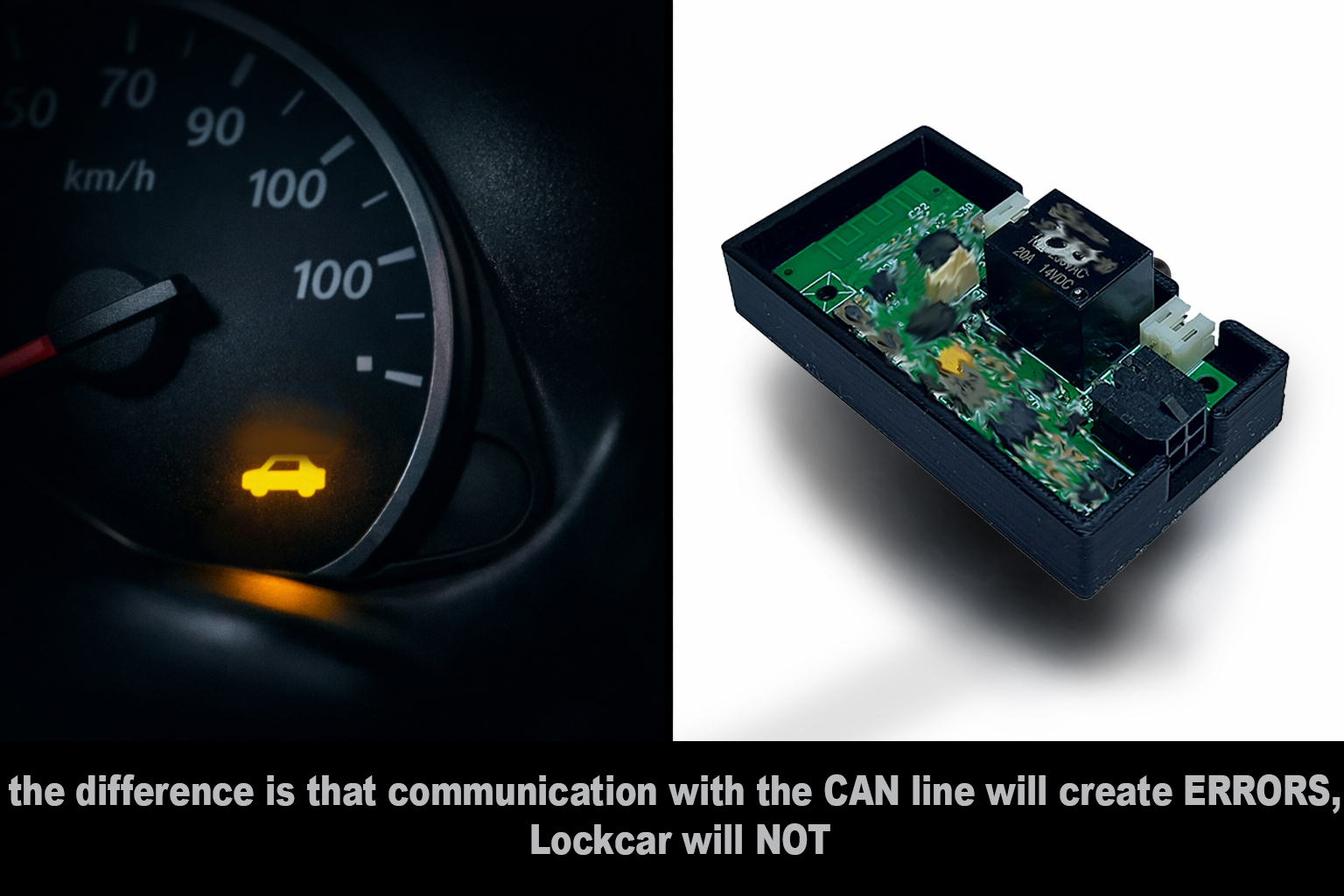 Why relay-based is safer
CAN bus connection vs physical relay. One talks to your car’s brain. One doesn’t.
Why relay-based is safer
CAN bus connection vs physical relay. One talks to your car’s brain. One doesn’t.
The three limitations buyers discover too late
Ghost does what it says it does. What it doesn’t say clearly enough — and what the forums make up for in uncomfortable detail — is the cost of the method it uses.
Limitation 1 — CAN bus interference and ECU risk
Ghost connects to your car’s CAN bus — the same network your engine management unit, ABS, airbag system, and instrument cluster use to communicate with each other. This network was engineered for a specific set of authorised modules. Adding a device it wasn’t designed for introduces a variable the manufacturer did not account for.
In a meaningful number of vehicles — particularly European makes with tightly-timed ECU networks — this causes problems over time. Dashboard warning lights. Failed starts. Limp mode. Diagnostic codes that disappear when Ghost is removed and return when it’s reinstalled. Forum threads on T6 Forum, PistonHeads, and VW communities document this pattern in detail.
The bill when this happens: £120–180 per hour at a main dealer for diagnostic investigation. Owners report total costs of £400–800 before the cause is identified. In several cases, the entire Ghost unit was removed and refunded — leaving the owner with a diagnostic bill and no immobiliser.
A relay-based immobiliser has zero CAN bus contact. The issue is architecturally impossible. See our full technical explanation: CAN bus vs relay — the difference that could cost you £800 →
Limitation 2 — PIN sequence usability problems
Ghost’s disarm method requires pressing a specific sequence of buttons — typically on the steering wheel, window switches, or dashboard — before the car will start. This is clever design for concealment: there’s nothing visible for a thief to find.
In practice, owners report a consistent cluster of problems. Partners who don’t regularly drive the car struggle to remember the sequence. Incorrect PIN entry triggers a timed lockout — leaving drivers stranded. If a condition disrupts the sequence timing (lights on, specific electrical load), the input window can close before the PIN is complete.
This is not a fringe complaint. It appears consistently across every major UK forum where Ghost is discussed, and several Trustpilot reviews describe being stranded roadside because the PIN sequence failed under real conditions.
LockCar uses proximity tags (hands-free, 1.5–5m range) and the app. You walk up. It knows it’s you. No sequence to remember, no lockout possible, no partner training session required.
Limitation 3 — Missing features that the market now expects
Ghost was designed as a single-function device: immobilisation. When it was launched, that was the category. Since then, the market has moved. Owners now expect — and competing products now offer — 4G remote access, live camera feeds, GPS tracking, automatic night-time arming, Face ID driver recognition, and full app control.
Ghost offers none of these as standard. The basic Ghost system has no GPS. No remote immobilisation from your phone. No live camera. No automatic arming schedule. No way to see what’s happening at the car when you’re not there.
The LockCar ONE Plus includes all of the above at £199 — comparable fleet-grade security systems cost £1,500–2,500 per vehicle from dedicated providers.
“I was stuck on the road. I couldn’t figure out why my PIN was not working and was on the verge of just towing it.”
— Ghost owner, Trustpilot review
“Today is the first time Mrs. Odd has driven it since Ghost was fitted. I had to go over the sequence with her before she could start it.”
— Motorhome owner, MotorhomeFun forum
“I doubt it will get stolen now as we can’t always start it first time ourselves.”
— UK car owner, automotive forum
“The Ghost being CAN bus does its cut electronically, not manually — that’s the risk. I’d always go for an old school relay immobiliser that physically cuts a circuit or two.” — Experienced UK car owner, PistonHeads
Full head-to-head: Ghost vs LockCar
Here is every meaningful dimension compared directly. Ghost’s strengths are listed honestly — where it has an advantage, that’s stated. The goal is a complete picture, not a sales pitch.
| Dimension | Ghost (Autowatch) | LockCar (relay-based) |
|---|---|---|
| Immobilisation method | CAN bus — digital signal on ECU network | ✓ Physical relay — zero ECU contact |
| ECU interference risk | ✗ Documented cases — real forum evidence | ✓ Architecturally impossible — ECU never touched |
| Stops relay attacks | ✓ Yes | ✓ Yes |
| Manufacturer warranty risk | ✗ BMW, Volvo have declined claims on CAN bus devices | ✓ Non-invasive installation — ECU network untouched |
| Disarm method | Button sequence PIN — must be memorised. Lockout if wrong. | ✓ Hands-free proximity tag or app — just walk up |
| App control | Basic | ✓ Full Wi-Fi app, remote immobilise, Face ID |
| 4G remote access | ✗ Not available | ✓ Yes — ONE Plus |
| Live camera feed | ✗ Not available | ✓ Yes — ONE and ONE Plus |
| GPS tracking | ✗ Not included | ✓ HYPER GPS+GLONASS — ONE and ONE Plus |
| Night auto-immobilise | ✗ Not available | ✓ Automatic at preset hours — ONE Plus |
| CAN injection vulnerability | ✗ Bus-level device — potentially exposed | ✓ Physical relay can’t receive a command |
| Smartwatch / wearable support | ✗ No | ✓ IS357 and ONE Plus — smart ring / watch support |
| Works on EVs and HGVs | Vehicle-specific | ✓ All 12/24V — cars, vans, EVs, HGVs, motorhomes |
| Price (product + fitting, approx.) | ~£450–600 fitted | ✓ £300–500 fitted (IC3ST/IS357) |
| Made in UK | Distributed UK; manufacturer origin unclear | ✓ Designed and built by Victor, UK |
| Installer = manufacturer | ✗ Separate installer network | ✓ Victor builds it and installs it. One contact. |
| Brand recognition | ✓ Very high — category-defining | Growing — pre-revenue stage |
| Installer network size | ✓ Large national network | Currently direct only — Victor installs |
Ghost wins on two dimensions only: brand recognition and installer network size. Both of these are distribution and marketing advantages — not technical ones. On every dimension that affects your car’s safety, health, and long-term operation, a relay-based immobiliser is equal or superior.
Decision guide: who should choose what
Different buyers have different priorities. Here is an honest guide to which product is the right choice based on what matters most to you — not just a blanket recommendation.
Your situation
Best choice
Your BMW, Mercedes, Volvo, or VW Group car is under manufacturer warranty. You need protection without risking warranty rejection if an ECU fault develops.
LockCar — relay-based, zero ECU contact, safe for warranty
You want hands-free operation — no PIN to remember, no button sequence, no lockout risk. You or your partner use the car daily and want it to just work.
LockCar — proximity tag auto-disarms as you approach
You want 4G remote access, live camera, GPS, and automatic night immobilisation. You want to be able to act from anywhere, not just find out the car is gone in the morning.
LockCar ONE Plus — the only product at this price with all of these
You drive a hybrid or electric vehicle (Lexus, Toyota, BMW i-series, Tesla-class). You need an immobiliser compatible with hybrid/EV drivetrains.
LockCar — works on all 12/24V, relay operates independently of hybrid systems
You’re a tradesperson with a keyless Ford Transit or similar van. The van is your livelihood and contains tools worth thousands.
LockCar IC3ST or ONE — standalone, 12/24V, installed at your premises
You want the most widely recognised brand name and have access to a large national installer network. Brand recognition and installer choice are your primary criteria.
Ghost — largest UK installer network
You’ve already had Ghost fitted and it’s working fine with no issues after 12+ months. Your vehicle and installation have no problems to date.
No change needed — monitor for ECU issues
The honest summary: if installer network size or brand name are your primary criteria, Ghost has an advantage. For every other criterion — technical safety, usability, features, price, warranty protection — a relay-based immobiliser is equal or better.
The LockCar alternative range — which product fits you
LockCar makes nine products across three categories. For buyers switching from Ghost or considering it for the first time, here are the three most relevant alternatives and who each one is for.
Most popular B2C choice
IC3ST
£139 from £300 fitted
Best Ghost alternative
Standalone — no MCU required. Proximity tag at 1.5m. Full Wi-Fi app. Works on cars, vans, EVs, HGVs. Zero CAN bus contact. The direct Ghost replacement for most individual car owners.
View IC3ST →
Premium personal vehicles
IS357
£149 from £320 fitted
Best for BMW / Range Rover
Everything in IC3ST plus 5m proximity range, Bluetooth, and smartwatch/smart ring trust device. Walk up wearing your watch — car already disarmed. For high-value vehicles where maximum detection range matters.
View IS357 →
Maximum protection
ONE Plus
£199 from £380 fitted
Everything Ghost can’t do
4G remote access, live camera, GPS+GLONASS, Face ID, automatic night immobilisation. Everything Ghost lacks, in one device. Fleet-grade spec at personal price. The right product if you want full remote control and automatic protection.
View ONE Plus →
Not sure which fits you?
Tell us your vehicle
Victor will tell you exactly which product is right for your specific make, model, and situation. No upsell. If the IC3ST is enough — that’s what he’ll say.
WhatsApp for a free recommendation →
LockCar — what you get that Ghost doesn’t offer
Recommended relay alternative
- Physical relay: engine circuit is cut at the hardware level — nothing to hack, no command to send, no bus to inject
- UK-engineered: Victor designed every circuit, wrote every line of firmware, and builds every unit himself
- Fitted at your door: Victor comes to you — no finding an installer, no trusting a stranger with your car’s wiring
- Full app: Wi-Fi app, remote immobilise, Face ID, motion detection, valet mode — not the PIN-only experience
- 4G + GPS: available in ONE Plus — real-time tracking and remote response, not just prevention
- Night auto-immobilise: ONE Plus locks down automatically at preset hours — no manual arming required
- Price: IC3ST from £300 fitted vs Ghost at £450–600 fitted — comparable or better protection for less
The relay-based Ghost alternative — fitted at your door
LockCar IC3ST — standalone relay immobiliser
No CAN bus. No ECU contact. No PIN sequence. Proximity tag disarms as you approach. Full Wi-Fi app. Professionally fitted by the engineer who built it. This is what Ghost should have been.
View the IC3ST → Get a free installation quote£139product only
from £300 fitted
from £300 fitted
The bottom line
Ghost is a good product that solved a real problem and built a strong brand doing it. If it’s already fitted to your car and working without issues, there’s no emergency. Monitor for ECU symptoms and carry on.
If you’re buying for the first time — or if you’re reconsidering after reading the forum evidence — the question to ask is not “which immobiliser is most famous?” It’s “which immobiliser is safest for my car’s electronics, easiest to use every day, and best value for the protection it provides?”
On all three counts, a relay-based immobiliser answers that question more clearly than Ghost can. And at £139 product-only, with professional installation by the engineer who built it, starting from £300 fitted — the price no longer gives Ghost an advantage either.
Ready to make the switch — or just want an honest recommendation? WhatsApp Victor directly with your vehicle make and model. He’ll tell you exactly which LockCar product fits, what the installation involves, and what it costs. No sales pressure. The person who built it, answering directly.