


We build car immobilisers from scratch – every architecture, every vehicle
The hardware, the firmware, the app. Designed and built in the UK by a team of automotive electronics engineers, each with more than twenty years in the field, coordinated by Victor. This is the story of how LockCar works, what is actually inside our devices, and why we cover every immobilisation method: CAN bus, LIN bus, ADC and relay.
We are engineers before we are anything else. Our team has spent more than two decades each in automotive electronics – ECU diagnostics, vehicle networks, embedded firmware, and aftermarket security. When we set out to build a vehicle immobiliser, we did not start with a business plan. We started with a circuit board and a problem we could not stop thinking about.
What follows is not marketing copy. It is the technical and commercial reality of how LockCar came to exist, what is inside the devices we make, the engineering decisions behind them, and why those decisions matter for anyone who owns a car worth protecting.
You can make up your own mind about whether any of it is worth your time. But it is all true, and it is all ours.
The problem we kept seeing
We had been watching the UK vehicle theft statistics for a long time before we started building anything. The numbers had been rising sharply since 2015, and the method driving that increase was specific: relay attacks on keyless entry vehicles. According to DVLA data reported by What Car? in February 2026, 54,830 vehicles were stolen in 2025 alone, equating to 150 cars every single day, and that figure is still more than twice the number stolen a decade ago in 2015.
The aftermarket had answers to this, and good ones. What it did not have, in our view, was a single manufacturer that designed and built across every immobilisation architecture, understood each one properly at board level, and then fitted the result itself. Most of the market specialises in one method and fits that method to every vehicle that comes through the door. We wanted to be the team that picks the right method for the car in front of us.
So the constraint we set ourselves before we had a product at all was breadth done properly: every architecture engineered in-house, to the same standard, by people who have worked with those networks since long before aftermarket security became a mainstream purchase.
Every immobilisation architecture, under one roof
This is the part of LockCar that people are usually most surprised by. We do not sell one method and describe everything else as the wrong choice. We build all of them, and we specify the right one for your vehicle, your parking situation, and how you actually use the car.
| Architecture | What it is and where it fits |
|---|---|
| CAN bus | Integration directly with the vehicle’s primary communication network. Invisible to the driver, no physical circuit modification, and the most sophisticated interaction with vehicle electronics. This is the area we are best known for, and where our twenty-plus years of ECU and network experience shows most clearly. Correct integration is a matter of knowing the vehicle’s timing, module map and diagnostic behaviour – which is precisely what our engineers do. |
| LIN bus | The lower-speed sub-network that handles doors, mirrors, seats, lighting and comfort modules. On many vehicles the cleanest and least intrusive integration point sits here rather than on the main CAN. We build for it, and we use it where the vehicle architecture calls for it. |
| ADC (analogue) | Analogue-to-digital signal monitoring for vehicles and applications where discrete inputs are the right control point. Useful on older platforms, commercial vehicles, and mixed fleets where a purely digital approach is not the best fit. |
| Relay | A 20A relay that physically interrupts an engine circuit. No presence on any network, no communication channel, nothing for a remote attack to talk to. Simple, robust, and extremely effective – particularly against relay-attack theft, which has nothing to do with the engine circuit at all. |
| Combined systems | Many of our installations use more than one layer: bus integration for intelligence and app control, plus a physical relay cut for hard immobilisation. Because we design every part ourselves, the layers are built to work together rather than bolted on top of each other. |
The short version: whatever your vehicle needs – CAN bus, LIN bus, ADC, relay, or a combination – we build it, we fit it, and we support it. One team, one point of accountability, every architecture.
Why we are the number one alternative for CAN bus immobilisers
CAN bus integration is the most demanding work in aftermarket vehicle security, and it is where our experience counts for the most. A CAN bus immobiliser sits on the network the manufacturer calibrated for a specific set of modules communicating in a specific pattern. Getting that right is not a matter of plugging something in. It is a matter of knowing the platform.
Our engineers have spent their careers on those networks. We map the vehicle before we commit to an integration point, we verify diagnostic behaviour after fitting, and we test the installation before we hand the car back. That is the difference between a device that lives happily on a modern European ECU network and one that was never specified for it.
The same standard applies to LIN bus and ADC work. And where a vehicle, an owner, or a parking situation is better served by a straightforward physical relay cut, we say so and we fit that instead. Recommending the right architecture is part of the service, not an upsell.
What is actually inside one of these devices
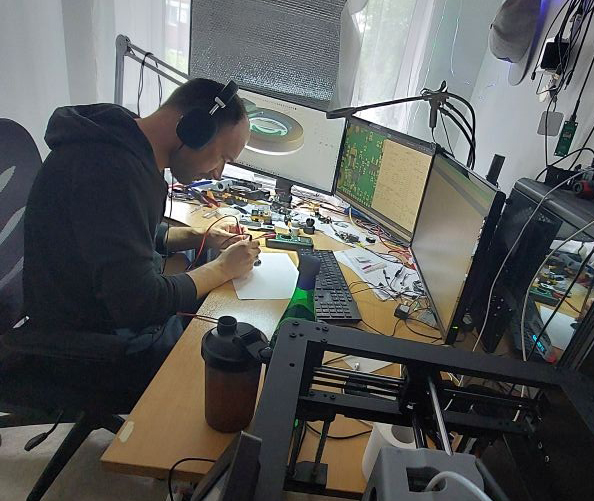
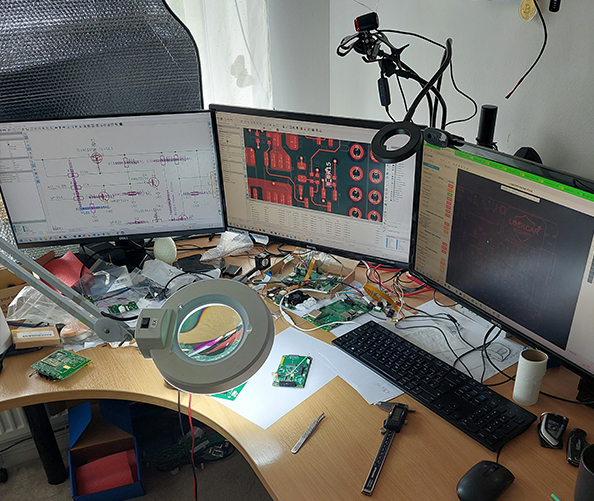
When we say we build from scratch, we mean it literally. Our team designs the PCB layout, specifies every component, writes the firmware that runs on the microcontroller, writes the Wi-Fi communication stack, builds the mobile app, and assembles the units.
This is not a reseller operation where a finished device is sourced abroad, labelled, and sold as a UK product. Every circuit board in a LockCar device was designed by our engineers, in the UK, to solve a specific engineering problem.
| What we build | Why it matters to you |
|---|---|
| PCB design | We know every trace, every component, and why each one is there. If something fails, we know what failed and why. No black box from a third-party manufacturer. |
| Firmware | The software running on the device is ours. We update it, patch it, and improve it. The proximity detection, the app communication, the bus integration and the relay timing are all written in-house. |
| Wi-Fi communication stack | The AES-128 encrypted wireless communication between the device and the proximity tag is our implementation. We chose the encryption standard, we implemented the protocol, we control the security properties. |
| Mobile app | The app you use to arm, disarm, and monitor the device was written by our team. When a feature needs adding, we add it. There is no third-party software vendor to wait for. |
| Bus integration | CAN, LIN and ADC integration is engineered per platform by people who have worked on vehicle networks for over twenty years. The integration point is chosen for the specific vehicle, then verified on the vehicle. |
| 20A relay specification | Where a physical cut is the right answer, the relay is rated to 20A and interrupts the engine circuit regardless of what signal the car receives from the key. A relay attack has nothing to do with the engine circuit, so it has nothing to work with. |
| Installation | Our own engineers fit every device. They know exactly where to place the hardware for maximum concealment, because they designed it and they understand how thieves look for security hardware. |
Direct from the people who build it
We are careful about what we claim on cost, because manufacturing involves a range of variables and we do not want to overstate anything. What we can tell you honestly is that buying from LockCar means buying from the manufacturer. There is no distribution chain between the engineers who designed the device and the customer who owns it, and no intermediary margin layered on top of a wholesale price.
On the metrics that matter most in vehicle security – does it immobilise the vehicle reliably, is it integrated correctly for the platform, does it arm and disarm hands-free without a PIN sequence, and is there someone accountable behind it – our systems are built to a standard we are happy to have examined in detail.
What building and installing every device ourselves actually means
In most of the industry, the manufacturer and the installer are different businesses. The customer buys from one entity and is then connected with a separate person to do the installation. We do both, and that changes several things in practice.
One point of accountability
We designed it, we built it, and we fitted it. If anything needs attention, there is no gap between manufacturer and installer for a problem to fall into. One team stands behind every installation, start to finish.
We know exactly where everything is
When our engineer places hardware in a specific location on a specific vehicle, they know why that location was chosen, how accessible it is to an informed thief, and what tools and time would be needed to reach it. If it ever needs servicing or replacing, the record is ours and the team is still here.
App setup is done properly before we leave
We do not hand over a product and assume you will work out the app. Before we leave, the app is paired, the proximity tag is confirmed at the correct detection range, motion detection is tested, and valet mode has been demonstrated. We wrote the app, so we can answer any question about it on the spot.
Direct access to the engineers
If something needs attention at 11pm on a Sunday, you reach the team directly. Not a chatbot, not a ticket queue, not an email answered in three to five business days. The people who built the device and fitted it, responding themselves.
What we are building towards
LockCar is built on a solid base: in-house hardware design, in-house firmware, in-house production, our own installation standard, and a team whose engineers have each spent more than twenty years in automotive electronics. The products are proven in the field, the range covers every immobilisation architecture, and the market gap we identified when we started building is real and it has not closed.
What we are building is a vehicle security company known for its engineering: a company where the people who make the product are the people who stand behind it, and where choosing the right architecture for a vehicle is an engineering judgement rather than a sales script.
In 2025, the top three most stolen vehicle makes in the UK according to DVLA data were Ford, BMW, and Toyota. The relay attack method that drives most of these thefts has not become harder to execute. The devices to carry it out have not become more expensive. The problem is not going away.
The nine products we build
LockCar currently offers nine products across three categories. Every one of them was designed and built in-house, and between them they cover CAN bus, LIN bus, ADC and relay immobilisation, specified to the vehicle. Here is the range:
The IC3ST (£139) and IS357 (£149) are the systems most individual car owners should start with. Both are standalone, requiring no separate Main Control Unit. Both use wireless proximity tags for hands-free operation. The IS357 extends detection range to 5 metres and adds Bluetooth and smartwatch support. Both can be specified with the integration method that suits your vehicle.
The ONE Plus (£199) is the most feature-complete system we make. It adds 4G remote access, live camera, GPS and GLONASS tracking, automatic night immobilisation at preset hours, and Face ID driver recognition. Fleet-grade capability at a price that is accessible to individual owners, because you are buying from the manufacturer.
The remaining products in the range – the i124, i125, i226, ic326, and iS326 – are primarily for dealer and installer partners, or for customers who need a device to integrate with an existing LockCar MCU setup. They are available at wholesale pricing for garages and auto electricians who want a UK-engineered range that covers every immobilisation architecture from one supplier.
Start with the IC3ST or IS357
Both are standalone immobilisers with no MCU required. Proximity tag hands-free operation, full Wi-Fi app, and the integration method specified for your vehicle. Fitted by the engineers who designed and built them. From £139.
View IC3ST (£139) View IS357 (£149)from £300 fitted
Who we let install our systems
LockCar is an established manufacturer with a solid engineering base behind it: our own hardware design, our own firmware, our own app, our own production, and a team of automotive electronics engineers with more than twenty years each in the field. We are not a start-up finding our feet, and we do not operate like one.
That scale is exactly why we are strict about who fits our products. The installation network is where a security company either protects its standard or quietly loses it, so partners do not simply sign up with us. They are vetted.
Proven technical background
Applicants must demonstrate genuine auto-electrical competence – vehicle network experience, diagnostic capability, and a verifiable history of work on modern platforms. We check it. Enthusiasm is not a qualification.
Training and certification by our own engineers
Every approved partner is trained by us, on our devices, across CAN bus, LIN bus, ADC and relay integration. Nobody fits a LockCar system until they have been signed off by the team that designed it.
Documented installations and ongoing audit
Partner installations are recorded, reviewed, and audited against our standard. Work that does not meet it is corrected, and partners who do not maintain the standard do not stay partners.
Accountability stays with us
Growing the network extends our accountability rather than diluting it. Whoever fits your vehicle, the engineering, the standard and the support behind it are ours.
If you are deciding who to trust with your vehicle’s security, this is the part that should matter to you: the product is engineered in-house by a serious team, and the hands that fit it have been through a process before they ever touch your car.
Want to talk to the people who build it? Message the LockCar team on WhatsApp with your vehicle details and where you park. We will tell you which architecture suits your car, which product fits, what the installation involves, and what it costs. No sales team, no call centre. The engineers who build the range, responding directly.