

What independent garages should know about aftermarket immobilisers
Customers already ask their garage about tyres, brakes and warning lights. More and more of them now ask whether their car is likely to be stolen, and what they can do about it. You do not need to become a security specialist to answer well. You need to know what the options are, which ones are worth your name, and when to raise the subject.
Why the factory immobiliser is not the whole answer
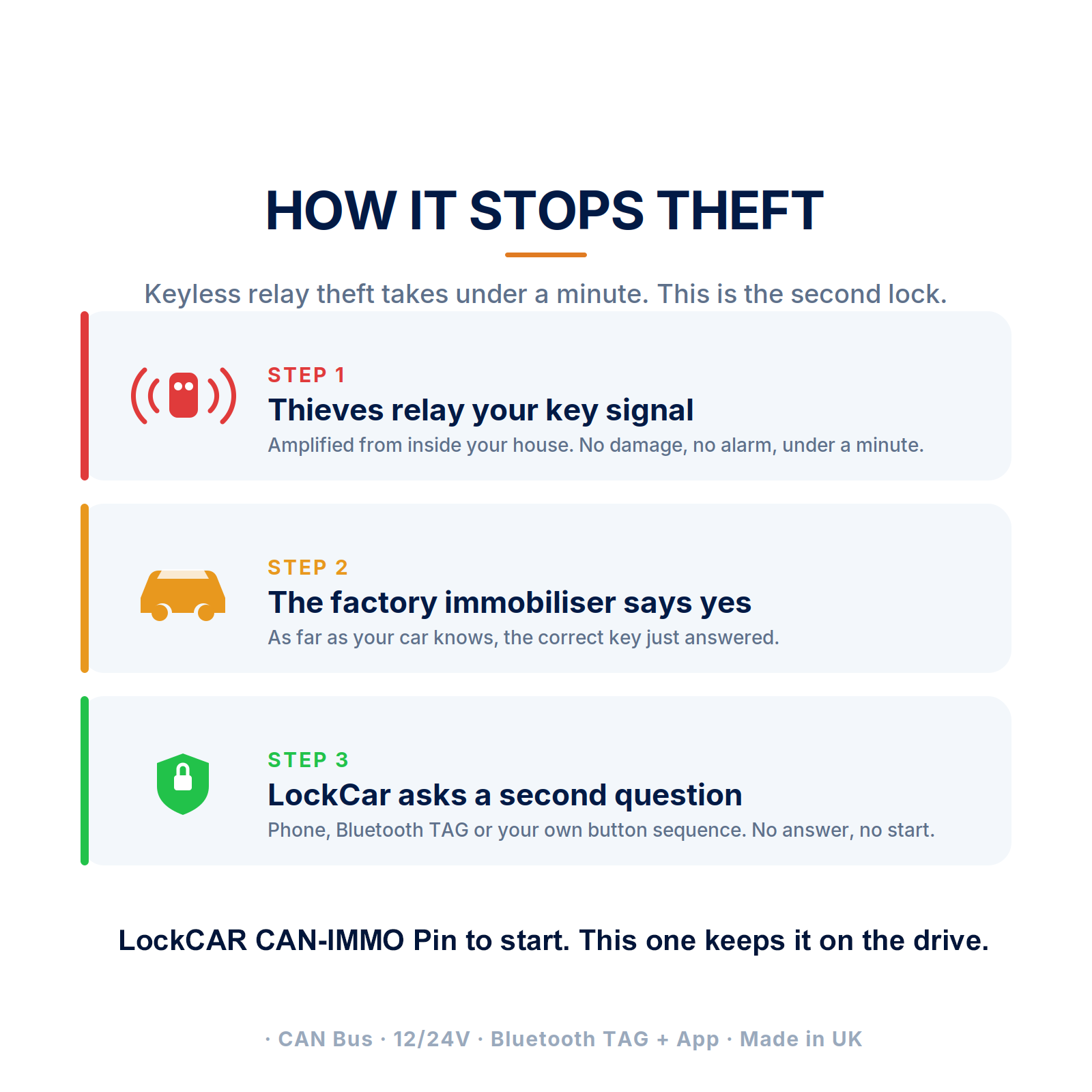
Every modern car has a factory immobiliser. Its job is to check that a valid key is present before the engine will start. The trouble is that most keyless theft does not defeat that check. It satisfies it.
Relay attacks, cloned keys and electronic attacks on the vehicle network all work by convincing the car that the right key is there. The factory system then does exactly what it was designed to do, for the wrong person. Your customers will not see a broken window or a forced ignition. They will see an empty driveway.
An aftermarket immobiliser closes that gap by adding a second, independent check that has nothing to do with the key. Even when the car believes its key is present, the engine stays blocked until the driver has authorised it separately.
The car asks one question: is the key here. An aftermarket immobiliser asks a second one, answered somewhere the thief cannot reach. That is a sentence any service advisor can say at the counter in ten seconds.
The main types you will come across
Customers arrive having read about all of these, often mixed together. It helps to know what each one actually does before a customer asks which is best.
| Type | How it works | Stops the car leaving | Workshop consideration |
|---|---|---|---|
| Relay based immobiliser | Interrupts a physical circuit such as the starter or fuel pump | ✓ Yes | Involves cutting into factory wiring, which some customers will not accept |
| CAN bus immobiliser | Joins the vehicle data network and holds the start until the driver authorises it | ✓ Yes | No cut wiring, module can be hidden almost anywhere, programmed per vehicle |
| Proximity tag only | Releases the car when a paired tag is nearby | ✓ Yes | Convenient, strongest when a PIN sits underneath as a fallback |
| Tracker with remote immobilisation | Locates the vehicle and can block it remotely | ✗ Mainly after the event | A recovery tool, usually with a monthly subscription |
| Steering lock or OBD lock | Physical barrier or a cover on the diagnostic port | Delays rather than stops | Cheap, visible deterrent, a useful extra but not a substitute |
For many customers the sensible answer is two of these together: something that stops the car being driven away, and something that helps find it if it goes anyway.
What to look for before you put your name to one
When a customer’s immobiliser goes wrong, they ring the garage that suggested it. These are the points that separate a product you can stand behind from one that comes back to bite you.
Nothing visible
If a thief can find a keypad, an LED or a control box, they have somewhere to start. The better systems use buttons the car already has, so there is nothing new in the cabin to spot.
Programmed for the vehicle
A unit configured for the exact make and model during installation behaves more reliably than a generic module guessing from voltage. It also means fewer odd faults turning up on your ramp later.
A proper service mode
Customers forget codes and flatten phones. A service or valet mode lets the car come into your workshop without the owner handing over their PIN, and lets your technicians road test it.
No lock in
A mandatory monthly subscription is a hard sell to someone who just wants the car to stay on the drive. One price, one warranty, done.
Easy to live with
Any step the driver has to repeat every journey gets abandoned around week three. A system that can release to a tag or phone, with the PIN kept as the fallback, is one that is still armed six months later.
Fitted properly
A good immobiliser fitted badly is worse than none. Concealment, clean wiring and correct configuration matter as much as the hardware itself.
When to raise it with a customer
You do not need to mention security to everyone who books an MOT. It is worth a conversation with customers who:
- drive a model commonly targeted for keyless theft
- park on the street overnight
- have had an attempted theft, or a neighbour’s car taken
- own a higher value or performance vehicle
- have just bought a used car and do not know how many keys exist
Very often the customer raises it first, usually after something has happened on their street. That is the moment a clear, calm answer from a garage they already trust counts for more than any advert.
The aim is not to sell. It is to make sure the customer knows factory security has limits and that there is a straightforward way to add a second layer. Some will say no, and that is fine.
Fit it yourself or refer it
Some garages prefer to refer customers to a specialist and keep their bays for servicing. Others see immobiliser installation as a natural extension of the workshop, because the diagnostic knowledge and trim experience are already there. Both are reasonable.
Refer the customer
Send the customer to us with the registration and postcode. We fit at their address, so the car does not tie up one of your bays, and you keep the relationship as the garage that pointed them the right way.
Fit it in your workshop
LockCar units are designed for professional installation through our installer network. If your workshop wants to fit CAN-IMMO itself, talk to us about joining.
Treat security fitting like any other job
If you take installations on, they need to run through the workshop the same way a service or an MOT does: booked against the vehicle, assigned to a technician and followed through to the invoice. Specialist fits are often booked weeks ahead, which is exactly when they slip through the gaps.
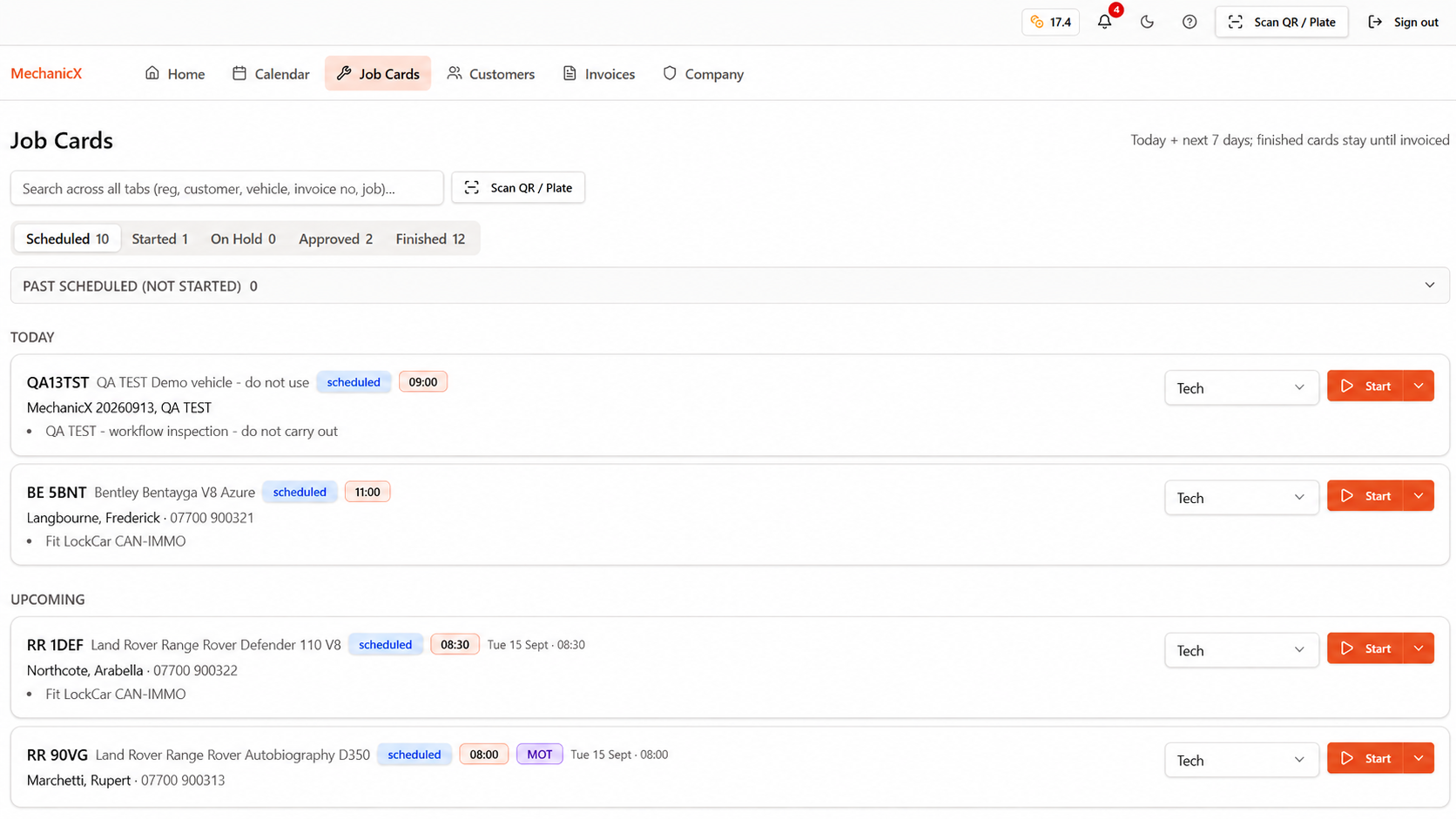
This is where MechanicX garage management software earns its place. An immobiliser installation sits on the digital job card next to everything else booked for the day: registration, customer, vehicle and assigned technician in one view, so a security job does not get lost among routine servicing.
Search works across registration, customer, vehicle, invoice number and job, and plates can be scanned straight into the system, which matters when a customer rings months later asking which unit was fitted to which car.
The daily brief on the home screen pulls out what needs attention: jobs on hold, jobs waiting to be invoiced, jobs nobody has been assigned to yet. For a workshop adding a new service line, that is the difference between a fit being booked and a fit being forgotten.
It is built as garage software for independent garages rather than dealer groups, so it suits the size of workshop most likely to be weighing up security work in the first place.
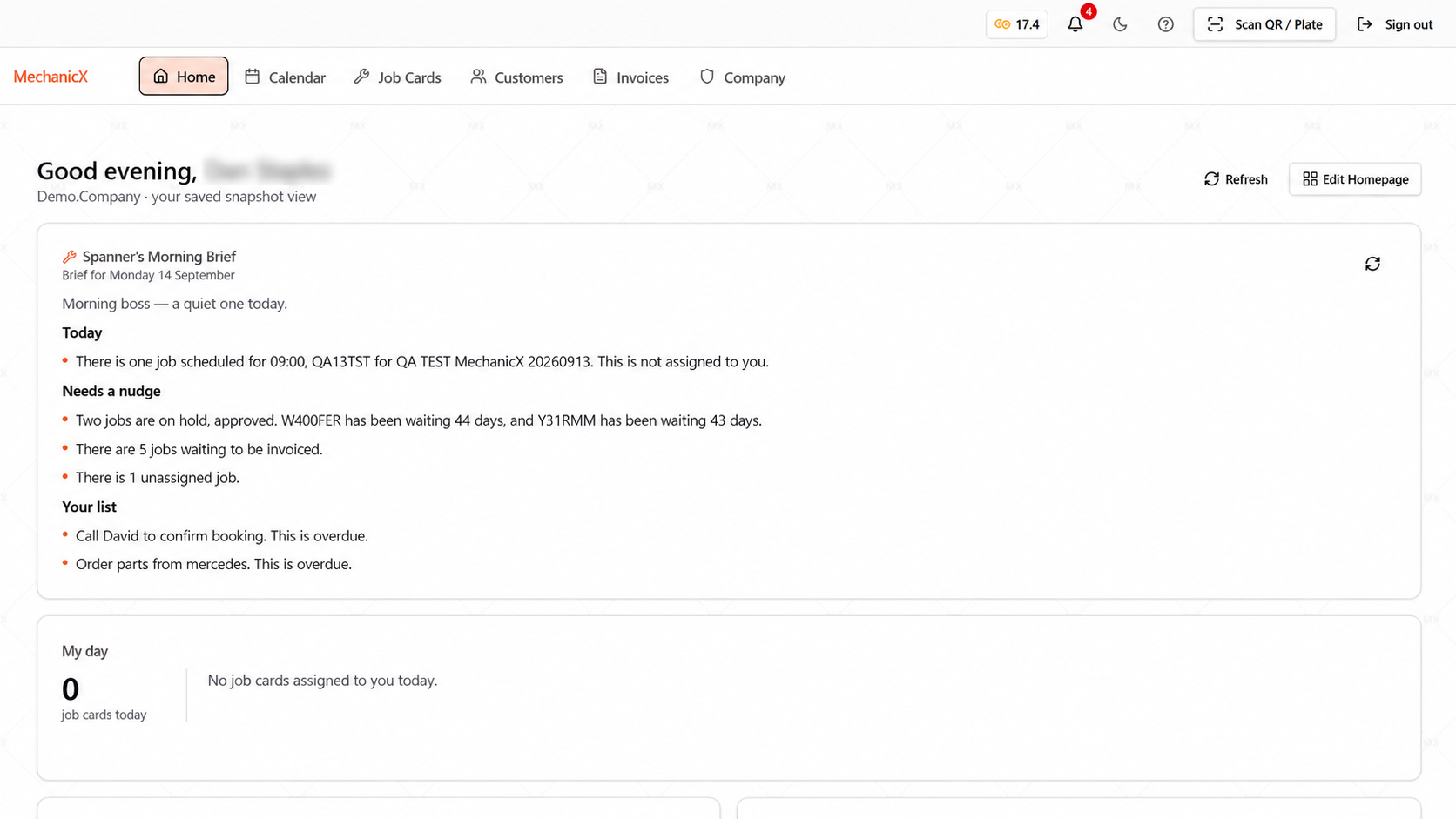
MechanicX is an online garage management system for UK independent garages and automotive businesses, covering job cards, calendar, customers and invoicing in one place. If you are looking for garage management software for independent garages, it is worth a look.
Where LockCar CAN-IMMO fits in
We make immobilisers, so read this section with that in mind. Everything above applies whichever product you end up recommending.
LockCar CAN-IMMO is a UK made CAN bus immobiliser and PIN to start immobiliser. The PIN is entered on buttons the vehicle already has, configured during installation, so there is no keypad, no LED and nothing obvious for a thief to find.
For daily use, a Bluetooth proximity tag, smart watch or smart ring can release the car automatically as the driver approaches, with the PIN always active underneath. That combination is what keeps customers using it rather than quietly switching it off.
It supports CAN bus, LIN bus and ADC bus vehicles, includes anti hijack protection, a shock sensor and valet mode, and carries a 12 month hardware warranty with no subscription. Full setup detail sits in the CAN-IMMO guide and user manual.
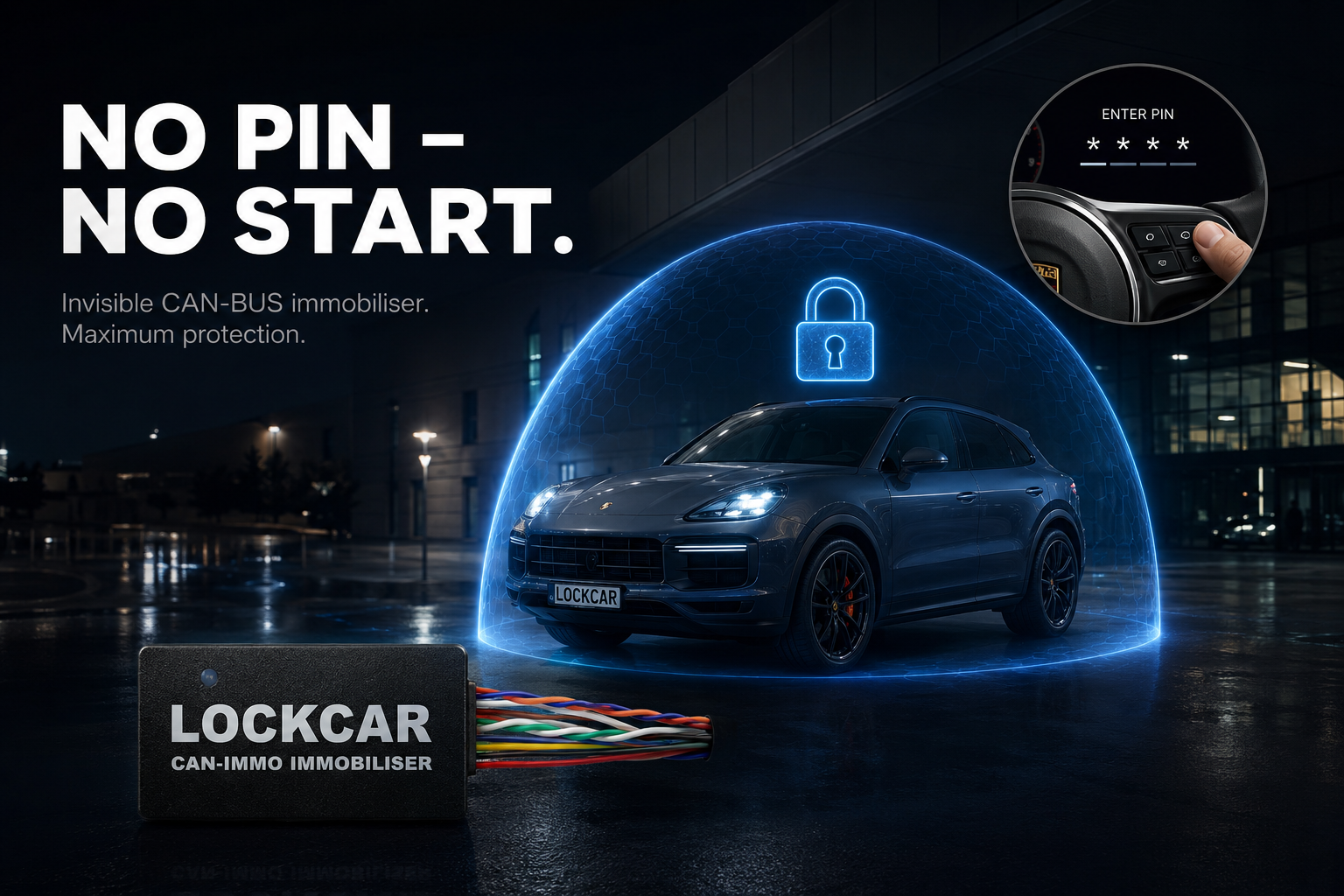
LockCar CAN-IMMO
Fitting included. Hidden CAN bus immobiliser with PIN to start and optional hands free release.
- CAN bus, LIN bus and ADC bus
- PIN entered on the vehicle’s existing buttons
- Tag, smart watch or smart ring release
- Hidden module, no LED, no keypad
- Anti hijack, shock sensor, valet mode
- 12V and 24V vehicles
- 12 month warranty, no subscription
The rest of our range, including tag only and 4G options, sits in the immobiliser category.
Questions garages ask us
Should an independent garage offer aftermarket immobilisers?
Offering advice costs nothing and customers expect it. Whether you fit them yourself depends on your bays and your technicians. Plenty of garages start by referring customers, then take installations in house once they see the demand.
Does a CAN bus immobiliser mean cutting factory wiring?
No. A CAN bus immobiliser joins the vehicle data network rather than interrupting a physical circuit, which removes the most common objection customers have. Warranty terms vary between manufacturers, so customers with cars still under warranty should check their own terms.
How do we work on a customer’s car once it has an immobiliser fitted?
With CAN-IMMO the customer puts the vehicle into service or valet mode before dropping it off. Your technicians can then move and road test it normally, and the customer never has to share their PIN.
Will an immobiliser satisfy an insurer’s security condition?
Not necessarily. If a customer’s policy specifies a Thatcham category tracker, only that device meets the condition. Tell them to ring their insurer before booking rather than assuming a discount.
How should we keep track of security installations?
The same way as any other job: on a job card against the registration, assigned to a technician and followed through to the invoice. Workshop management software such as MechanicX makes it easy to find later which unit went on which vehicle.
Refer a customer or fit it yourself
Send the registration and postcode for a customer referral, or tell us about your workshop if you want to fit CAN-IMMO in house.